By Akanksha Surana, Accounting Software Consultant at Perfonec Computers | Updated June 2026
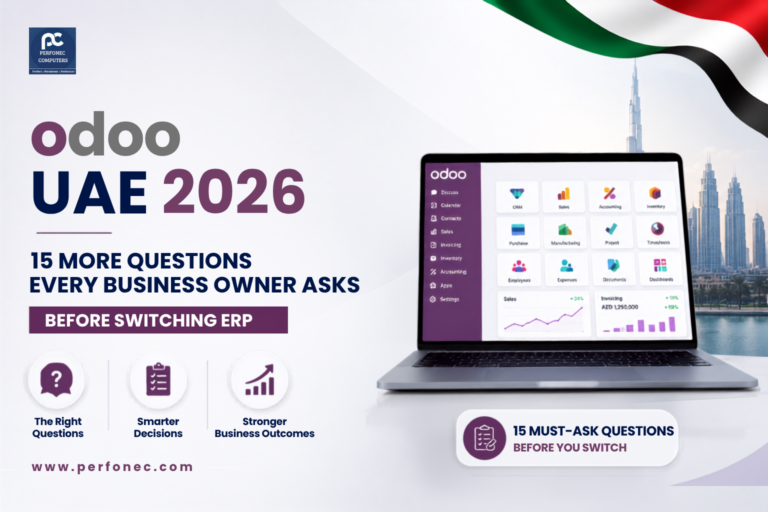
Quick answer: This is Part 2 of our Odoo UAE question series. In this guide we answer the next 15 most common questions UAE business owners ask about Odoo — covering e-commerce capabilities, data security, mobile app functionality, which Odoo version to choose, NetSuite comparison, integrations with UAE banks and third-party tools, manufacturing, ROI calculation, accounting compatibility, partner risk management, Community vs Enterprise, partner evaluation, implementation mistakes, and the free vs paid edition question. Complete Odoo implementation support is available from Perfonec Computers — authorised Odoo partner in Dubai.
In our first Odoo UAE guide, we answered the 15 most common questions UAE business owners ask before switching to Odoo — covering whether Odoo works in the UAE, how it compares to SAP and Oracle, implementation costs and timelines, UAE VAT and Corporate Tax compliance, partner selection, and data migration. In this second guide, we go deeper — answering the 15 follow-up questions that come next once a business has decided Odoo is the right direction.
📄 Want a printable reference?
Download our free Odoo UAE Features Guide — Community vs Enterprise comparison, NetSuite comparison, security checklist, UAE integrations, ROI calculation framework, and top 5 implementation mistakes.
Q16. Odoo for E-Commerce: Can It Handle Your Online Store in UAE?
For UAE businesses running or planning to run an online store, this native integration is the single most important advantage of Odoo’s e-commerce module. When a customer places an order on your Odoo website, the system automatically reserves the stock in your warehouse, generates a sales order in your accounting module, creates a delivery order for your logistics team, and records the customer’s details in your CRM — all simultaneously and without any manual intervention.
The Odoo e-commerce module supports UAE-specific requirements including AED pricing, UAE VAT at 5% applied correctly to applicable products, Arabic language for product pages and checkout, and integration with popular UAE payment gateways. Additionally, the website builder is drag-and-drop and does not require developer skills for day-to-day content updates. Contact Perfonec to discuss Odoo e-commerce implementation for your UAE business.
Q17. How Secure Is Odoo for Handling Business Data in UAE?
Odoo Enterprise includes several important security features as standard. Data is encrypted in transit using TLS and at rest depending on the hosting configuration. Role-based access controls allow you to restrict each user to only the modules and records relevant to their job — meaning your sales team cannot see payroll data, and your warehouse team cannot access financial reports unless specifically granted access. Every action in the system is logged with a timestamp and user identity, creating a complete audit trail that satisfies FTA record-keeping requirements.
For UAE businesses handling sensitive financial data, customer information, and employee records, Odoo’s security architecture is fit for purpose. The most important decision is hosting. Odoo Online — Odoo’s own managed cloud — handles security patches, backups, and uptime monitoring automatically. On-premise deployment gives you maximum control but requires a competent IT team to maintain. Perfonec advises on the right hosting option for your UAE business during the initial assessment.
Q18. Odoo Mobile App: Managing Your UAE Business on the Go
The Odoo mobile app provides real-time access to your Odoo database — meaning the data you see on your phone is the same live data your team is working with in the office. Managers can approve purchase orders, review pending invoices, check stock levels across warehouses, and view CRM pipeline status from their mobile device without needing to log into the full desktop interface.
For UAE field sales teams, the mobile CRM functionality is particularly valuable — logging customer visits, creating and sending quotations, and recording notes immediately after a meeting rather than retrospectively at the end of the day. The app also supports barcode scanning for warehouse operations, which is useful for UAE trading businesses doing physical stock counts. The mobile app works with any Odoo Online or Odoo.sh hosted instance and requires no separate purchase — it is included with your Odoo Enterprise subscription.
Q19. Which Odoo Version Should Your UAE Business Choose?
Odoo releases a new major version approximately once per year. Each version brings significant improvements to existing modules and often introduces entirely new capabilities. For UAE businesses implementing Odoo in 2026, the latest stable version is the correct starting point — it includes the most current UAE VAT localisation, the most up-to-date FTA invoice template formats, and the API integration capabilities needed for UAE e-invoicing compliance from 2027.
Businesses sometimes ask whether to implement an older version to avoid upgrade disruption. The answer is no — implementing an older version means you will need to upgrade sooner anyway, and you will miss compliance improvements in the meantime. Perfonec always implements the current latest stable Odoo version and provides upgrade support as part of ongoing maintenance contracts. Contact Perfonec to confirm the right Odoo version for your UAE business today.
Q20. How to Customise Odoo for Your Specific UAE Business Needs
Odoo customisation exists on a spectrum. At the lightest end, non-technical users can customise views, add custom fields to records, create custom report templates, and configure workflow stages without writing any code — these are called no-code or low-code customisations and can be done directly in the Odoo interface. At the more complex end, Odoo’s Python-based framework allows developers to build entirely new modules that extend core functionality for specific industry requirements.
For UAE businesses, the most common customisations Perfonec implements include Arabic and English bilingual invoice and delivery note templates, custom UAE management report formats, approval workflow configurations for purchase order thresholds, industry-specific product categorisation for trading and manufacturing businesses, and custom dashboards that show the specific KPIs relevant to the business owner. The key principle to follow is to use standard Odoo configuration wherever possible before resorting to custom development — this keeps upgrade paths clean and reduces long-term maintenance costs. Contact Perfonec to discuss customisation requirements for your specific UAE business.
Q21. Odoo vs NetSuite: Which Fits UAE Businesses Better?
| Factor | Odoo | NetSuite |
|---|---|---|
| Cost | ✅ Moderate per-user pricing | ❌ High — minimum AED 50,000+ per year |
| UAE localisation | ✅ Strong UAE VAT and CT module | ⚠️ Available but less mature locally |
| UAE partner support | ✅ Strong partner network in UAE | ⚠️ Fewer qualified UAE-based partners |
| Customisation | ✅ Open-source — highly customisable | ⚠️ SaaS model — limited customisation |
| Multi-subsidiary | ✅ Supported in Enterprise | ✅ Strong multi-entity feature |
| Best for UAE | 10 to 500 employees, UAE-focused | 50+ users, multi-country operations |
NetSuite’s strength is multi-subsidiary financial consolidation across multiple countries — a capability that most UAE-focused SMEs do not need. For a UAE trading company, distributor, manufacturer, or service business primarily operating within the UAE, Odoo’s feature set covers everything needed at a significantly lower total cost of ownership.
Q22. Can Odoo Integrate With Your Existing UAE Business Tools?
Odoo’s open API architecture means that virtually any system with an API can be integrated with Odoo — the question is whether a pre-built connector exists or whether custom integration development is required. For UAE businesses, Odoo supports direct bank feed integration with several UAE banks for automated bank reconciliation, reducing the manual work of matching payments to invoices. Payment gateway integrations for UAE e-commerce and point of sale operations are available for providers commonly used in the UAE market.
UAE WPS payroll integration — connecting Odoo’s HR and payroll module to the Wages Protection System for compliant monthly salary transfers — is a specific UAE requirement that Perfonec configures as part of every HR module implementation. For UAE e-invoicing from 2027, Odoo’s API allows connection to FTA-approved ASPs for PINT AE XML transmission, which is already being planned into current implementations. Contact Perfonec to discuss your specific integration requirements.
Q23. Odoo for Manufacturing: Streamlining Production for UAE Businesses
UAE manufacturing businesses typically need a system that connects purchasing of raw materials, production planning, shop floor execution, quality checks, finished goods inventory, and invoicing to customers — all while maintaining accurate product cost calculations for UAE VAT and Corporate Tax purposes. Odoo’s manufacturing module handles all of these within a single connected system rather than requiring separate software for each function.
The bill of materials module allows you to define exactly what components go into each finished product, including by-products and scrap. The MRP module calculates what raw materials need to be ordered based on sales orders and minimum stock rules — automating the purchase order generation process that manufacturing businesses often handle manually. Work orders define the steps on the production floor, and quality control checkpoints ensure products meet specifications before being moved to finished goods inventory. Production costs automatically flow into the accounting module, giving your finance team accurate cost of goods sold figures for every batch produced.
Q24. How to Calculate ROI on Odoo Implementation for UAE Businesses
To calculate your specific Odoo ROI, quantify the current cost of each inefficiency Odoo will address. Start with accountant time — how many hours per month does your accounting team spend on manual data entry, invoice reconciliation, and VAT return preparation? Multiply by the hourly cost of that time. Odoo typically reduces this by 60 to 70 percent, meaning the time saving alone often covers the ASP or support subscription cost within the first few months.
For trading and manufacturing businesses, calculate the cost of stock discrepancies — goods that cannot be found, overstock write-offs, and emergency purchases due to inaccurate reorder points. Odoo’s real-time inventory tracking with automatic reorder rules directly addresses this category of waste. For businesses that invoice on credit terms, calculate how many days on average invoices are outstanding beyond their terms — Odoo’s structured invoicing and delivery confirmation typically reduce this by 10 to 20 days, which has a direct positive impact on cash flow. Perfonec builds a business case ROI analysis as part of every Odoo UAE assessment.
Q25. Odoo Accounting: Does It Work With UAE Banks?
Bank reconciliation in Odoo works by matching imported bank transactions against outstanding invoices and bills in the system. The matching process uses a combination of amount, date, and reference number rules to automate the reconciliation where possible, flagging only unmatched transactions for manual review. For a UAE trading business processing hundreds of transactions monthly, this automated reconciliation can save several days of accountant time each month.
The Odoo accounting module also handles UAE-specific requirements including post-dated cheque management — which remains common in UAE B2B transactions — and multi-bank account management for businesses holding accounts across different UAE banks. VAT 201 return data is generated automatically from the tax configuration applied to each transaction, meaning quarterly FTA filing becomes a report export and review rather than a manual calculation exercise. For UAE e-invoicing from 2027, the accounting module will be the source of all PINT AE structured invoice data transmitted through your ASP connection. Contact Perfonec to discuss Odoo accounting configuration for your specific UAE bank setup.
Q26. What Happens If Your Odoo Partner Disappears in UAE?
This question reflects a legitimate concern — UAE businesses have had experiences with software vendors or implementation partners that closed, merged, or simply became unresponsive. With a proprietary ERP, this can leave a business in a genuinely difficult position since the code, data structure, and configuration knowledge may be inaccessible without the original vendor.
With Odoo, the situation is entirely different. The Odoo source code is open and documented. Your database belongs to you and can be exported at any time. Any certified Odoo partner in the UAE can take over support and maintenance of your existing Odoo instance. To further protect your business, ensure that your implementation partner documents all customisations clearly, that you retain access to your own Odoo database and hosting credentials, and that all custom code is stored in a version control system you have access to. Perfonec provides all clients with full documentation of their customisations and direct access to all system credentials.
Q27. Odoo Community vs Enterprise: Which Should UAE Businesses Buy?
| Feature | Community | Enterprise |
|---|---|---|
| Cost | Free | Per user per month subscription |
| UAE accounting localisation | ❌ Not included | ✅ Included |
| Full accounting module | ⚠️ Limited version only | ✅ Full featured |
| Mobile app | ❌ Not available | ✅ Included |
| Official Odoo support | ❌ Community forums only | ✅ Official helpdesk |
| Odoo.sh hosting | ❌ Not available | ✅ Available |
| Studio (no-code customisation) | ❌ Not available | ✅ Included |
The absence of the UAE accounting localisation module in Community alone makes Enterprise the only realistic choice for a UAE business. Building UAE VAT compliance from scratch on Community would cost significantly more in development time than the Enterprise subscription saves.
Q28. How to Evaluate Odoo Partner Credentials and Experience in UAE
Official Odoo partner status is verifiable — Odoo maintains a public partner directory on odoo.com where you can confirm whether a partner is officially listed and at which tier. Silver, Gold, and Platinum tiers reflect increasing levels of certified staff, implementation volume, and Odoo platform expertise. A company claiming to be an Odoo partner but not appearing in the official directory has no formal certification relationship with Odoo.
Individual Odoo certifications are separate from company partner status. Ask which specific members of the implementation team hold Odoo functional and technical certifications and request to see their certification documentation. A company with partner status but uncertified implementation staff represents a significant risk. Furthermore, always ask for UAE client references from completed implementations — specifically businesses in a similar industry to yours — and contact those references directly to ask about their experience. Learn more about Perfonec’s Odoo partner credentials and UAE implementation experience.
Q29. Odoo Implementation Mistakes to Avoid in UAE
Poor master data quality is the most common cause of a difficult go-live. Customer records with missing TRN numbers, product records without correct HS codes or VAT categories, and supplier records with incorrect payment terms will cause problems from the first day of live operation. Investing time in a thorough master data cleanup before implementation begins pays dividends immediately after go-live.
Skipping the user acceptance testing phase is the second most common mistake. UAT is where your team tests the configured system against real scenarios before go-live. Skipping it to save time means the first real transactions after go-live become your testing phase — which means errors happen in your live system affecting real customers, real invoices, and real compliance records.
Neglecting UAE-specific compliance configuration — particularly UAE VAT category assignments on products and services, FTA invoice template validation, and Corporate Tax chart of accounts setup — creates compliance exposure that can result in FTA audit findings. Perfonec’s implementation methodology specifically addresses all five of these risk areas as structured phases of every engagement.
Q30. Free vs Paid Odoo: Is the Free Version Enough for UAE Businesses?
The appeal of Odoo Community is obvious — it is completely free and includes the core modules for sales, inventory, manufacturing, and basic accounting. However, for a UAE business with VAT obligations, the accounting module in Community is a significantly reduced version that lacks the UAE localisation, VAT report generation, bank reconciliation automation, and multi-currency revaluation features that Enterprise includes.
The practical outcome for UAE businesses that attempt to run on Community is that they end up spending more on custom development to replace the missing UAE compliance features than the Enterprise subscription would have cost in the first place. Furthermore, the custom developments they build are harder to maintain through Odoo upgrades than the standard Enterprise features they replaced. Odoo Community is excellent for developers experimenting with the platform or businesses in markets with minimal compliance requirements. For UAE businesses with FTA obligations, Odoo Enterprise is the only appropriate starting point. Contact Perfonec for an exact Odoo Enterprise pricing quote for your UAE business.
Get Odoo Implemented Correctly for Your UAE Business
Perfonec Computers is an authorised Odoo partner in the UAE. We handle complete Odoo implementation — UAE VAT configuration, Corporate Tax setup, FTA e-invoicing integration, data migration, module configuration, staff training, and post-implementation support across Dubai and the UAE.
ISO 9001:2015 certified. Dubai-based team. Free Odoo UAE assessment available.
📞 +971 4 386 6199 | 📧 sales@perfonec.com | 💬 WhatsApp Us
About the author
Akanksha Surana
Akanksha Surana is an Accounting Software Consultant at Perfonec Computers, Dubai, with 9 years of experience implementing QuickBooks, Zoho Books, TallyPrime, and Odoo ERP for UAE businesses. She specialises in UAE VAT compliance, FTA e-invoicing integration, Odoo UAE implementation, Corporate Tax configuration, and ERP selection advisory for SMEs across Dubai and the wider UAE.
Frequently Asked Questions — Odoo UAE Features and Capabilities
Does Odoo have an e-commerce module that works in UAE?
Yes. Odoo’s built-in e-commerce module creates a fully functional online store connected directly to inventory, accounting, and CRM. It supports AED pricing, UAE VAT at 5%, Arabic language, and UAE payment gateway integrations — all natively within Odoo without third-party connectors.
Should UAE businesses choose Odoo Community or Enterprise?
Odoo Enterprise is the correct choice for UAE businesses. Community lacks the UAE accounting localisation module, full accounting features, mobile app, and official support. The cost of custom development to replace missing UAE compliance features in Community typically exceeds the Enterprise subscription cost. Contact Perfonec for an exact Enterprise pricing quote.
Is Odoo better than NetSuite for UAE businesses?
For most UAE SMEs and mid-market businesses, Odoo is the better choice — stronger UAE localisation, lower cost, a more established UAE partner network, and open-source customisability. NetSuite is better suited for larger multi-subsidiary businesses with complex multi-country financial consolidation needs.
What are the most common Odoo implementation mistakes in UAE?
The five most common mistakes are poor master data quality, skipping user acceptance testing, choosing Community edition, going live without a parallel run period, and neglecting UAE VAT and Corporate Tax compliance configuration. All five are preventable with a structured implementation methodology. Contact Perfonec for a structured Odoo UAE implementation.
Does Odoo integrate with UAE banks?
Yes. Odoo supports bank feed integration with UAE banks for automated reconciliation. Manual import via Excel or CSV is also fully supported. The accounting module handles AED as base currency, multi-currency, post-dated cheques, and UAE VAT 201 report generation.
What happens if my Odoo partner closes or becomes unavailable in UAE?
Because Odoo is open-source, your data and system are never locked to a single partner. Any certified Odoo partner in the UAE can take over support and maintenance of your existing instance. Ensure your original partner provides full documentation of customisations and that you retain direct access to all system credentials. Perfonec provides all clients with complete documentation and direct credential access.
Published by Perfonec Computers — Authorised Partner for Odoo ERP, QuickBooks, TallyPrime, Zoho Books, and Sage 50 in the UAE. Based in Manama Street, Dubai, UAE. Based on publicly available Odoo and FTA information as of June 2026. Verify current requirements at odoo.com and tax.gov.ae.